Choosing among China’s top 10 high-voltage and low-voltage solar batteries requires more than comparing capacity and price. The key question is: what is the difference between high voltage and low voltage solar batteries? In simple terms, high-voltage systems connect more battery modules in series. They deliver greater voltage with lower current, which can reduce cable losses and support powerful hybrid inverters. Low-voltage batteries usually operate around 48 volts. They offer simpler installation, broader compatibility, and easier module replacement.
Dr. Imre Gyuk, a leading U.S. Department of Energy energy-storage expert, has described storage as “a game changer” for modern power systems. That view matters in real homes. A high-voltage battery may respond efficiently when an air conditioner starts at noon. A low-voltage unit may feel more practical for a small household using lights, appliances, and backup power overnight. Neither choice wins everywhere. Not quite.
This guide examines China’s leading battery options through usable capacity, cycle life, round-trip efficiency, safety design, warranty coverage, and inverter compatibility. It also considers installation space, communication protocols, and after-sales support. These details can matter more than a large capacity label. A 10 kWh battery still disappoints if only 8 kWh is usable. A cheaper system may also create avoidable costs when connectors or software fail to match. Product specifications can change, so buyers should verify current certifications, test reports, and local installer experience before purchasing.
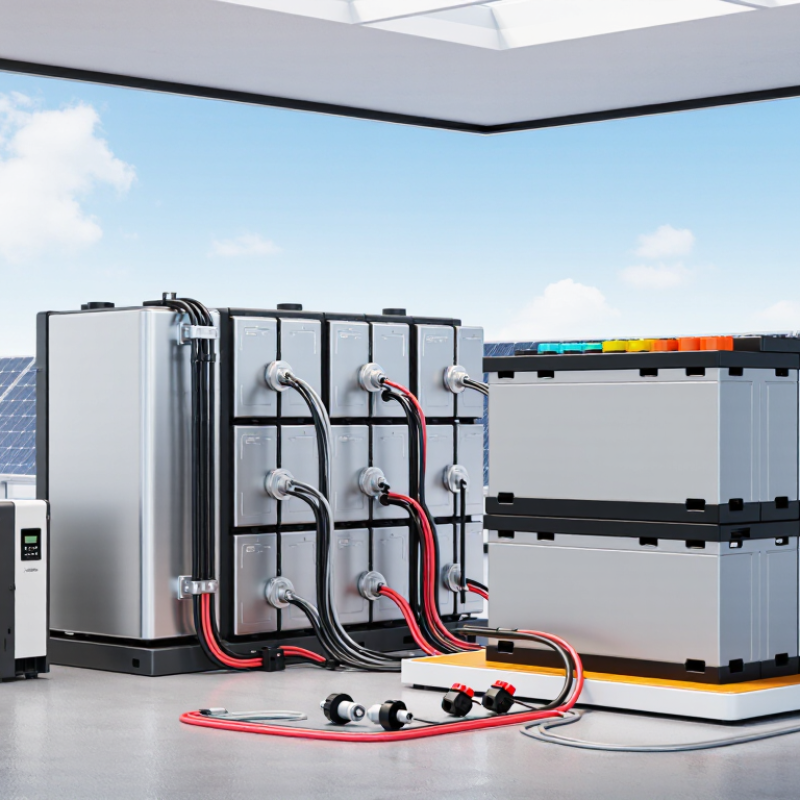
High- and low-voltage solar batteries store energy through similar electrochemical reactions, but their electrical architecture differs. Low-voltage systems commonly operate around 12, 24, or 48 volts. They connect modules in parallel, increasing capacity while keeping voltage stable. High-voltage systems connect battery modules in series, often reaching several hundred volts. The inverter then converts stored direct current into usable household alternating current.
For the same power output, higher voltage means lower current. This can reduce cable losses and allow smaller conductors, especially in larger home or commercial installations. However, high-voltage systems require stricter insulation, isolation, pre-charge control, and communication between the battery management system and inverter. Low-voltage batteries usually simplify servicing and offer flexible expansion, but high current may create heat, voltage drop, and greater cable costs. The “better” choice depends on system size, cable distance, inverter compatibility, and local electrical requirements.
Tips: Check the battery’s continuous current rating, not only its peak power. Confirm voltage compatibility before installation. Keep cables short, properly rated, and securely terminated. During commissioning, review temperature readings and cell balance. A small mismatch can become noticeable after repeated cycling. I also treat advertised capacity carefully, because usable energy changes with discharge limits, temperature, and battery age.
China Top 10 High vs Low Voltage Solar Batteries Explained
High-voltage and low-voltage batteries differ mainly in electrical architecture, current, efficiency, and installation requirements. A typical low-voltage system operates near 48 volts, while high-voltage systems may operate between 200 and 600 volts. For a 10-kilowatt load, a 48-volt battery delivers about 208 amps. A 400-volt system needs only 25 amps. Lower current reduces cable size and electrical losses, especially in long cable runs.
High-voltage systems often suit larger homes, commercial projects, and hybrid inverters designed for higher power. They can provide smoother energy transfer, but installation demands stricter insulation, protection, and commissioning procedures. Low-voltage batteries remain practical for small residential systems. They are usually easier to expand and troubleshoot, though parallel connections can increase current and cable requirements. The choice is not purely about efficiency.
The International Energy Agency reported that global battery storage additions in the power sector exceeded 40 GW in 2023, showing how quickly storage designs are scaling. NREL’s 2024 Annual Technology Baseline commonly models lithium-ion round-trip efficiency around 85% to 95%, depending on system design and operating conditions. Real installations may perform worse during cold weather, partial loading, or poor thermal management. That detail is often overlooked. A high-voltage battery is not automatically better; inverter compatibility, usable capacity, safety controls, warranty conditions, and local installation expertise still determine practical value.
| Comparison Dimension | High-Voltage Solar Battery Systems | Low-Voltage Solar Battery Systems |
|---|---|---|
| 1. Typical DC voltage range | Usually above 100 V DC, with many residential and commercial systems operating approximately between 150 V and 600 V DC. | Commonly based on 12 V, 24 V, or 48 V nominal architectures; modern residential systems frequently use approximately 48–51.2 V nominal battery packs. |
| 2. Current required for the same power | Requires less current. For example, a 10 kW load at 200 V requires about 50 A before accounting for conversion losses. | Requires more current. A 10 kW load at 50 V requires about 200 A before accounting for conversion losses. |
| 3. Cable size and power losses | Lower current can reduce I²R cable losses and may allow smaller conductors over comparable distances, provided the insulation and voltage ratings are suitable. | Higher current generally requires larger cables, stronger terminals, and careful connection design to limit voltage drop and heat generation. |
| 4. Power and scalability | Well suited to higher-power systems because the battery current remains comparatively low. Expansion normally requires compatible high-voltage modules, racks, or battery strings. | Well suited to small and medium power systems. Higher power may require parallel battery units, larger conductors, and higher-current protection equipment. |
| 5. Inverter compatibility | Must be matched with a high-voltage battery inverter or hybrid inverter that supports the battery’s voltage window, communication protocol, and protection requirements. | Compatible with low-voltage battery inverters and many 48 V-class off-grid, backup, and residential energy-storage platforms. |
| 6. Safety and installation requirements | Higher DC voltage increases electric-shock and arc-flash hazards. Installation requires appropriate isolation, fusing, clearances, insulation, labeling, and qualified electrical work. | The lower voltage reduces some electric-shock risks, but high fault currents can still cause severe arc energy, overheating, or fire if protection and connections are inadequate. |
| 7. Battery management system | Typically uses cell-level monitoring together with module and system-level voltage, current, temperature, insulation, and contactor monitoring. | Usually has a simpler voltage architecture, but the BMS must manage high current, cell balancing, temperature limits, overcurrent protection, and parallel-unit coordination. |
| 8. Round-trip efficiency | Can benefit from lower conductor losses at higher power, but actual round-trip efficiency depends on the cells, battery electronics, inverter, operating temperature, and load profile. | Can also achieve high efficiency when correctly designed, although cable, busbar, fuse, and connection losses become more significant at high current. |
| 9. Typical applications | Commonly considered for larger residential installations, three-phase systems, commercial storage, peak shaving, and applications requiring substantial continuous power. | Commonly used in smaller residential systems, backup power, off-grid installations, recreational vehicles, telecommunications, and modular home-energy systems. |
| 10. Main selection considerations | Choose when system power, lower current, compact high-power wiring, and integration with a suitable high-voltage inverter are priorities. Confirm local electrical-code requirements before installation. | Choose when simpler architecture, broad 48 V-class equipment availability, flexible modular expansion, and easier serviceability are priorities. |
Note: Voltage ranges and installation practices vary by battery chemistry, system design, inverter specifications, and local regulations. Always verify the manufacturer’s electrical ratings and applicable safety standards.
China’s solar battery market covers ten practical categories. High-voltage systems include modular stacks, wall-mounted units, floor-standing cabinets, all-in-one storage, and DC-coupled batteries. They suit larger homes, multi-phase buildings, and commercial projects.
Higher voltage can reduce current and cable losses. Installation still requires qualified electrical work.
Low-voltage options include rack-mounted batteries, wall-mounted batteries, floor cabinets, portable power stations, and AC-coupled storage. Rack models work well in equipment rooms. Wall units save space. Floor cabinets offer easier expansion.
Portable units support temporary loads, while AC-coupled batteries can connect with existing solar inverters.
Chemistry matters too. Lithium iron phosphate is widely chosen for thermal stability and cycle life, though performance depends on temperature, charging limits, and maintenance.
Check voltage compatibility before comparing capacity.
A 48-volt battery may not replace a high-voltage system.
Measure the installation area, cable distance, and ventilation conditions.
Ask for usable capacity, not only the advertised figure.
Review protection features, certifications, warranty terms, and service response.
Real projects sometimes reveal a gap between laboratory data and daily performance.
That deserves attention.
Don’t size storage from one cloudy week alone; household load patterns can change quickly.
China Top 10 High vs Low Voltage Solar Batteries Explained
Battery capacity should be compared by usable kilowatt-hours, not only the advertised nominal figure. Depth of discharge, temperature, and reserve settings change daily output. In field checks, a battery rated at 10 kWh may deliver less during cold winter nights. That detail is often missed. High-voltage batteries usually carry the same power with lower current. This can reduce cable losses and support efficient inverter operation. Low-voltage systems use higher current, so cable size and connection quality become more important. They may offer simpler expansion for small homes.
Safety deserves closer attention than capacity labels. A dependable system needs cell balancing, temperature sensors, overcurrent protection, and a responsive battery management system. High-voltage units require stronger insulation and careful isolation during installation. Low voltage is not automatically risk-free. Humidity near coastal areas can weaken connectors, while dust and heat affect outdoor enclosures. Qualified technicians should check clearances, ventilation, grounding, and shutdown controls. Small installation errors can create large reliability problems.
Efficiency depends on more than battery chemistry. Compare round-trip efficiency, inverter compatibility, standby consumption, and performance at partial loads. A high-voltage system may perform well in larger homes with long cable runs. A low-voltage system can suit modest loads and phased upgrades. However, manufacturer test conditions are not always identical. I would request measured data at the intended temperature and load. Real households rarely operate at laboratory settings. That uncertainty deserves honest consideration.
Representative residential LiFePO₄ battery benchmarks for comparing capacity, safety, and efficiency
Low-voltage systems commonly use approximately 48–52 V battery modules, while high-voltage systems often operate around 200–500 V. High-voltage batteries generally provide lower current for the same power output, which can reduce cable losses and improve system efficiency.
The chart uses representative module values: low-voltage batteries at about 5.12 kWh and 90% round-trip efficiency, compared with high-voltage batteries at about 10.24 kWh and 95% round-trip efficiency. Actual performance depends on battery chemistry, inverter compatibility, operating temperature, installation quality, usable depth of discharge, and protection circuitry.
Both voltage classes can be safe when correctly engineered. Safety depends mainly on cell quality, battery management systems, thermal protection, enclosure design, electrical isolation, and compliance with applicable storage and installation standards.
High-voltage and low-voltage batteries serve different system designs. High-voltage units usually reduce current, cable losses, and inverter stress. They suit larger homes, commercial sites, and three-phase systems. Low-voltage batteries remain practical for smaller homes, off-grid cabins, and modular upgrades. However, voltage alone does not prove better performance. Check the inverter’s permitted voltage range, communication protocol, maximum charge current, and battery expansion limits.
The International Energy Agency’s Batteries and Secure Energy Transitions report projects global battery storage capacity will need to expand sixfold by 2030. This growth increases product choice, but it also increases comparison risks. Look beyond advertised capacity. Compare usable energy, round-trip efficiency, cycle-life testing, thermal management, and warranty conditions. NREL’s 2024 storage assumptions commonly model lithium-ion round-trip efficiency near 85%. Real results may differ because of temperature, standby use, and partial cycling. That uncertainty deserves attention.
Request independent test reports, not only factory brochures. Confirm IEC 62619, UN 38.3, and local grid requirements with your installer. For a high-voltage battery, verify emergency shutdown behavior and insulation monitoring. For a low-voltage system, check cable size and parallel-connection limits. A five-kilowatt-hour battery may look affordable, yet its usable capacity can be lower after reserve settings. Ask for measured data at your expected temperature. One overlooked detail can reshape the payback period.
Low-voltage systems often operate near 48 volts. High-voltage systems may operate between 200 and 600 volts.
A 10-kilowatt load needs about 208 amps at 48 volts. It needs about 25 amps at 400 volts.
High-voltage batteries often suit larger homes, commercial buildings, and three-phase systems.
Low-voltage batteries suit smaller homes, cabins, and gradual system upgrades.
No. Efficiency also depends on the inverter, temperature, standby use, and thermal management.
Check the inverter voltage range, communication method, charge current, and expansion limits.
Compare usable capacity. A five-kilowatt-hour battery may deliver less after reserve settings.
Confirm insulation monitoring, emergency shutdown behavior, protective equipment, and qualified commissioning.
Cold weather, partial loading, and weak thermal control can reduce real-world performance.
Lithium iron phosphate is commonly selected for thermal stability and long cycle life.
This guide explains the definitions, operating principles, and practical differences between high-voltage and low-voltage solar batteries. It answers the question, “what is the difference between high voltage and low voltage solar batteries,” by examining how voltage affects current, wiring, inverter compatibility, system efficiency, installation requirements, and scalability. High-voltage systems can reduce current and energy losses in suitable applications, while low-voltage systems may offer simpler configuration and broader flexibility for smaller installations.
The article also introduces ten major categories of high- and low-voltage solar batteries available in China, organized by voltage range, battery chemistry, application, modular design, and storage capacity. It highlights key comparison factors, including usable capacity, safety features, charging performance, cycle life, thermal management, monitoring functions, and total system efficiency. Finally, readers will learn how to select an appropriate Chinese solar battery by matching voltage, capacity, inverter compatibility, installation conditions, budget, and long-term energy needs.

Luzz Solar